

FoodSwitch scans products and recommends healthier alternatives to switch to
Simply scan a barcode or search for a product by name to get its nutrition information and healthier alternatives. FoodSwitch uses science-based algorithms developed by The George Institute for Global Health. FoodSwitch was accredited by ORCHA with a review score of 74%, making it a trusted source for health advice. Whether you’re looking for products lower in calories, fat, sugars, or salt, FoodSwitch will help you find healthier foods and beverages when grocery shopping.
Download FoodSwitch
The FoodSwitch app is available for download in these jurisdictions:
Terms and conditions (Global)
Terms and conditions (Australia)
Privacy policy


How the FoodSwitch app works

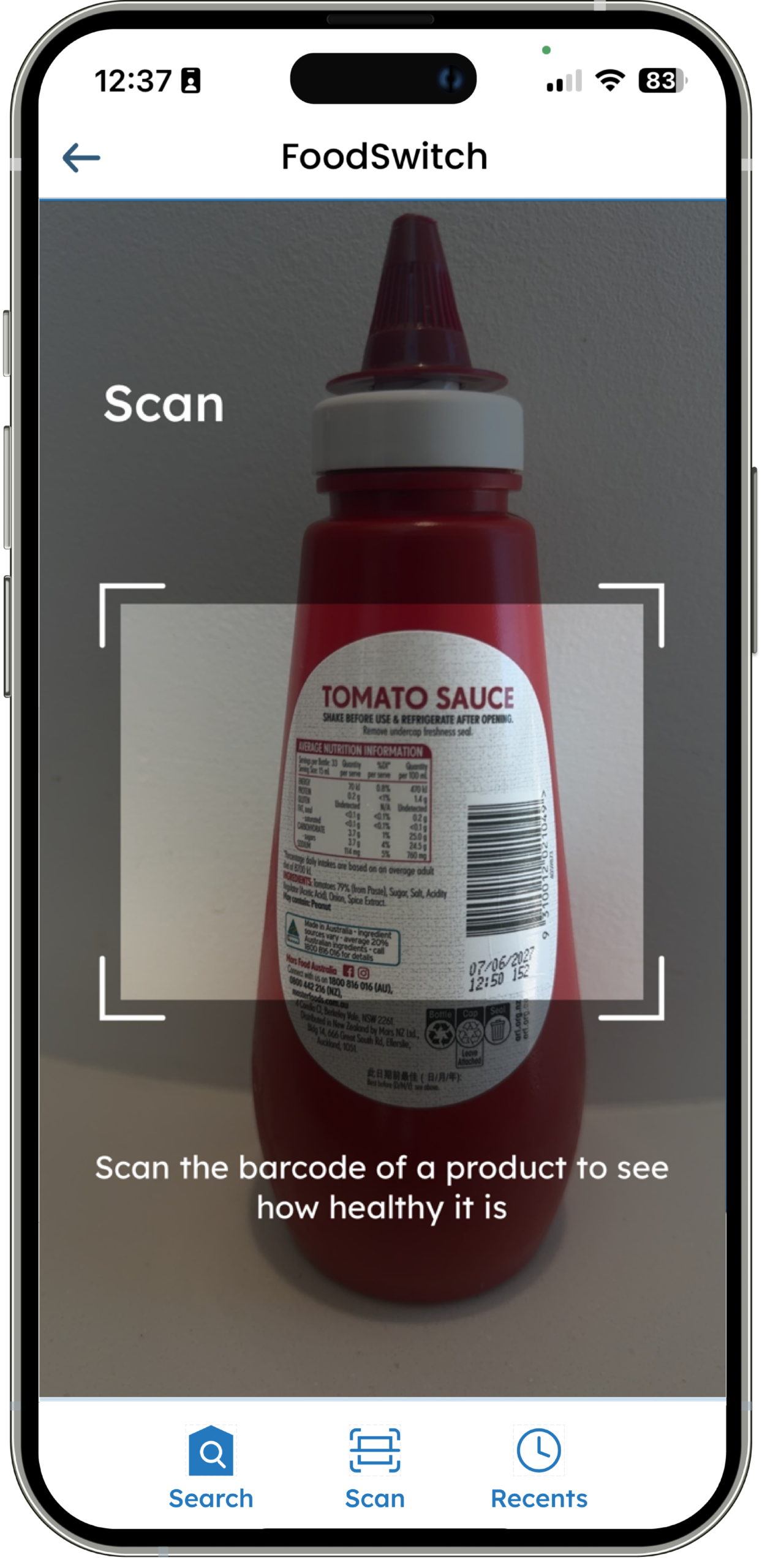
Scan
Scanning the barcode of a packaged food or beverage will find the product data held in our database. The app holds data on over 100,000 items. If the items isn’t in our database, you’ll be asked to ‘help us out’ and upload some photos of the item to help update our database.

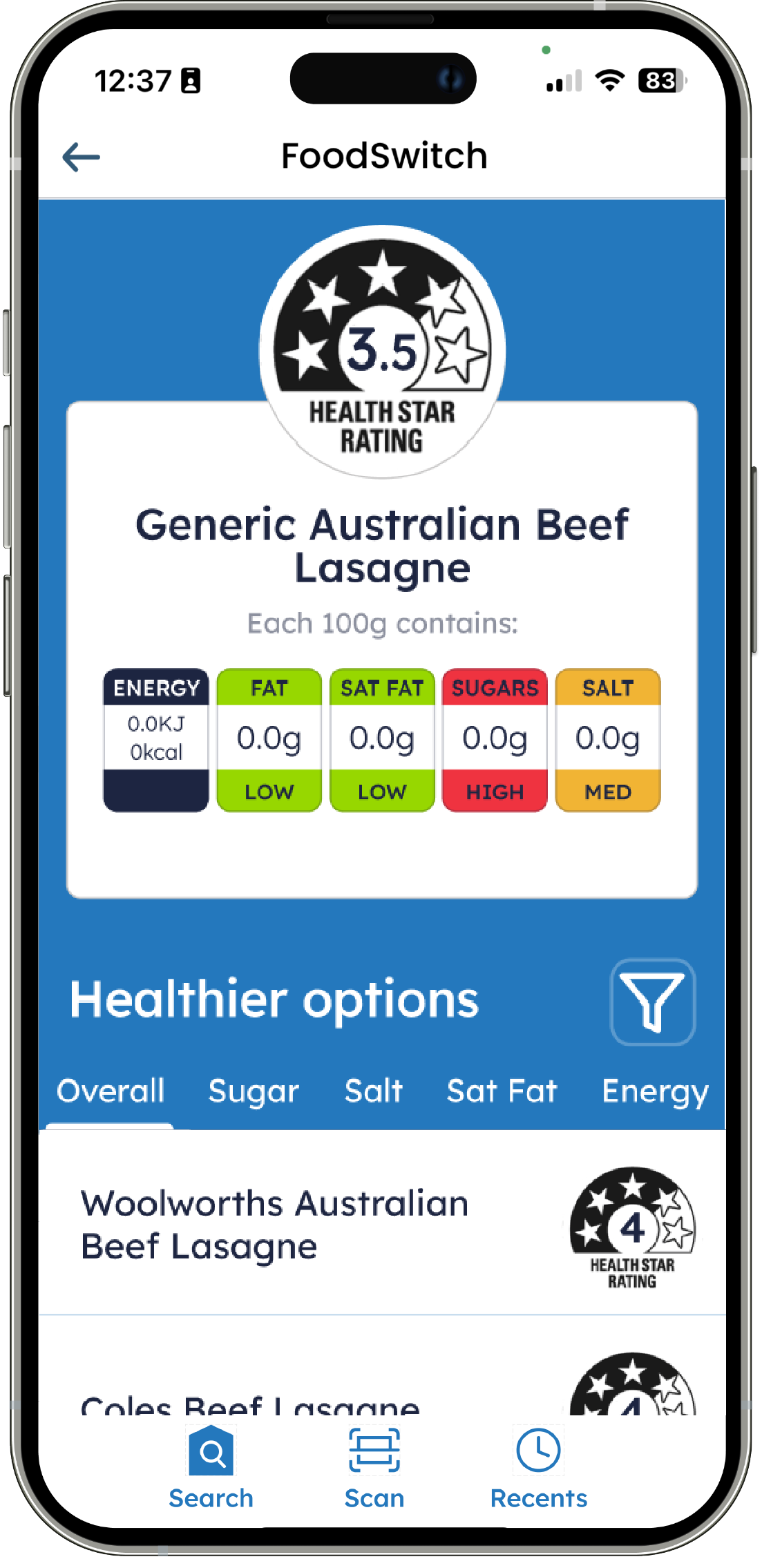
See health data and healthier options
The results page of a scan displays the Health Star Rating (HSR) of that item – scored between 0.5 stars (least healthy) to 5 stars (healthiest), along with colour coded information on specific nutrients. The app will also present a list of healthier alternatives that are similar to the scanned item based on their underlying HSR points.
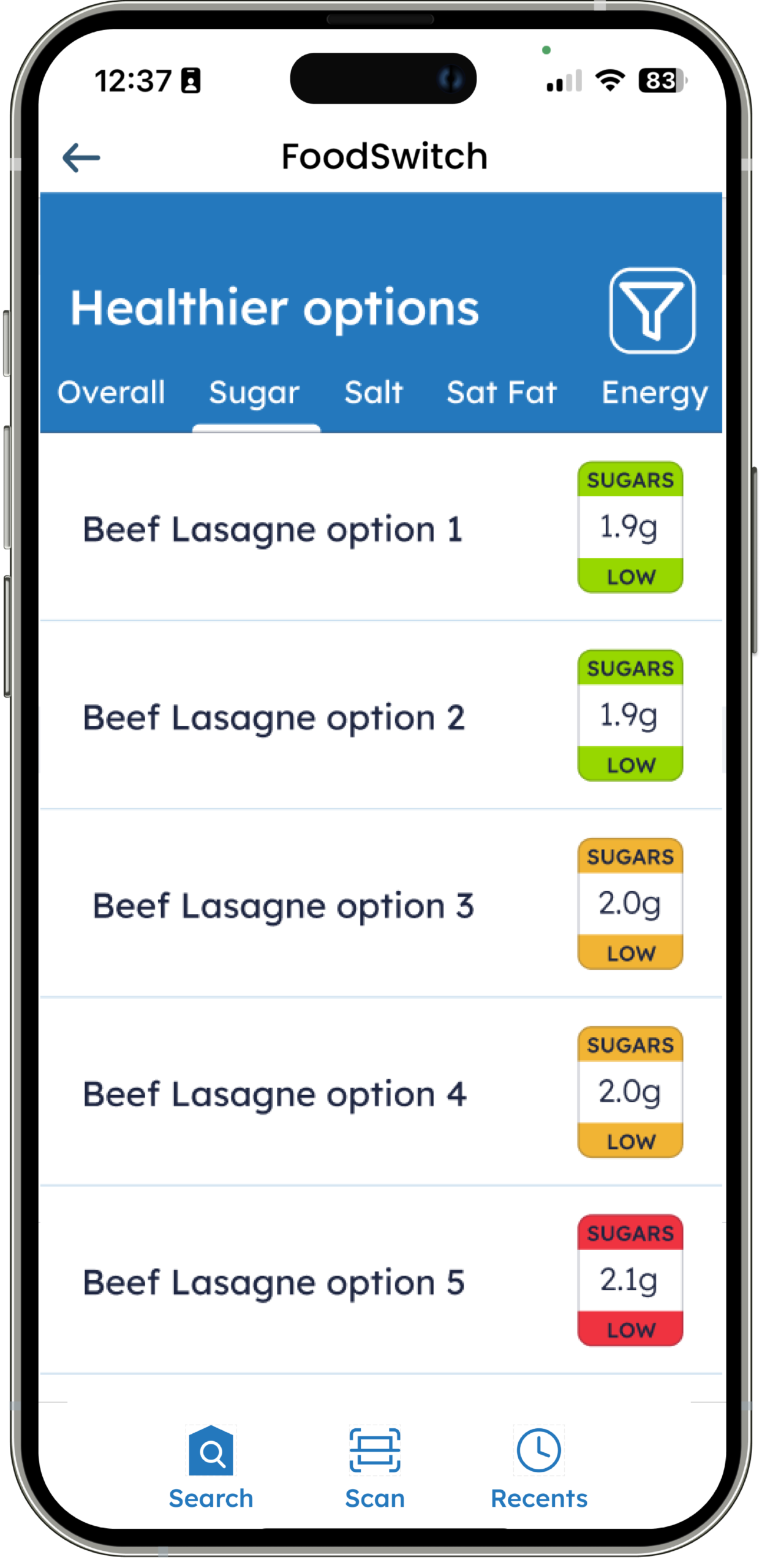
Sort healthier options by nutrient content
As well as presenting healthier options ranked by their overall healthiness, you can see options based on overall health and lower in a particular nutrient or energy. Beef Lasagne option 1 in this example would be healthier than the scanned item and have the lowest amount of sugar.
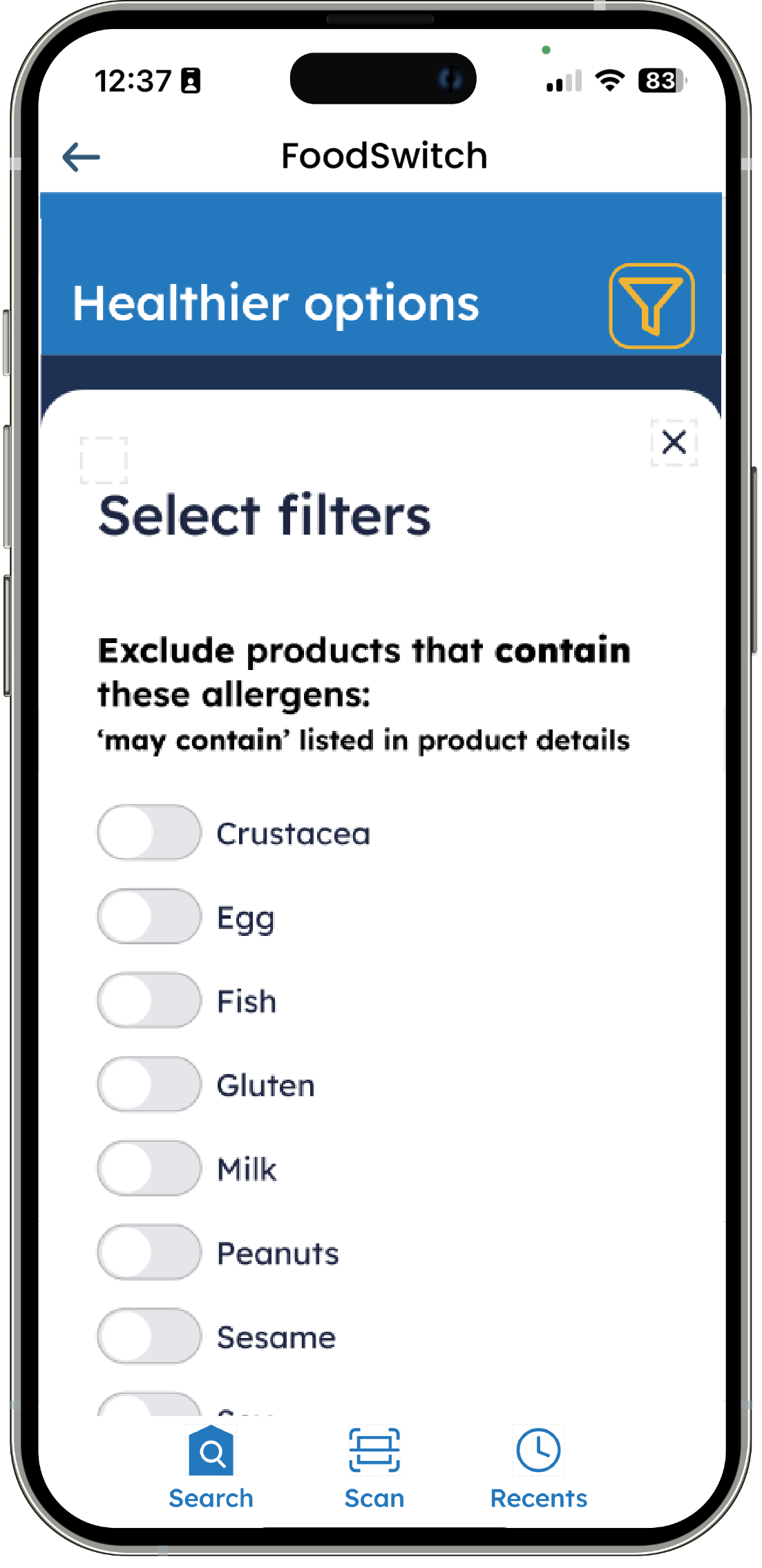
Filter to exclude allergens and select stores
Select the Filter button and you have the choice to exclude items listed as healthier choices that contain one or more allergens. The healthier choices will continue to list items that ‘may contain’ selected allergens.
You can also select one or more stores to limit healthier options based on store availability.
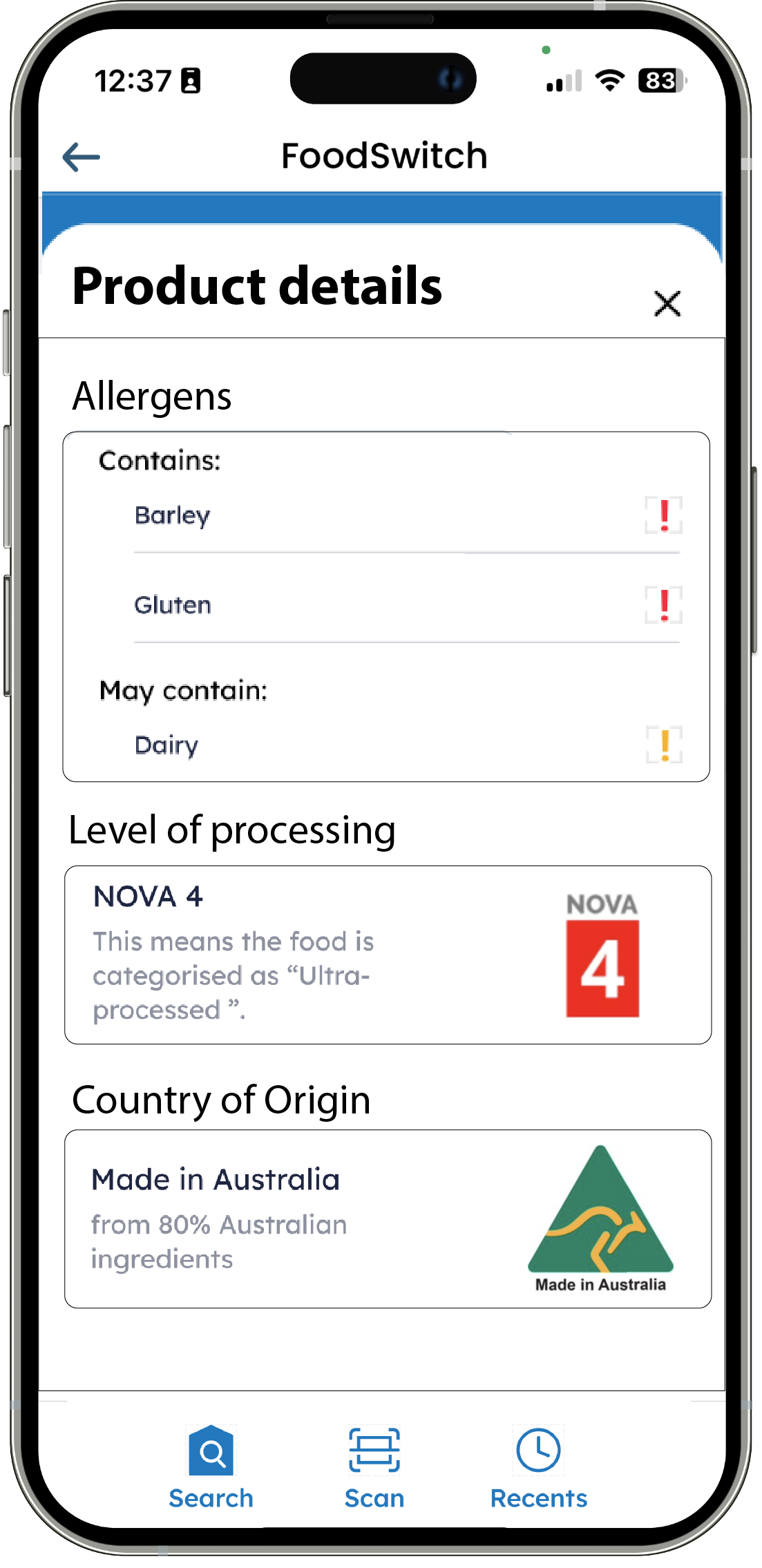
View product details
View more detailed nutrient information; an estimate of added sugar; allergens declared on the label – both ‘contains’ and ‘may contain’; manufacturer health and product claims; Level of Processing (e.g. Ultra Processed); and Country of Origin information.
Frequently asked questions
FoodSwitch gives you immediate, easy-to-understand health information about packaged food products, as well as a list of similar foods that are healthier choices. You can access this through the app by scanning the product barcode using your phone camera. Product information is shown as Health Star Rating mode and colour coded nutrient tabs.
The Health Star Rating (HSR) considers several factors to give you an idea of how healthy the product is overall; a lower star rating indicates a less healthy choice and a higher star rating indicates a healthier choice. The Health Star Rating is calculated based on its food category and the amount of energy, saturated fat, total sugar and sodium as well as other important food components including protein, dietary fibre, its fruit, vegetables, nuts and legumes (FVNL) content, and for some products, calcium.
FoodSwitch lists healthier choices based on their overall health using the underlying points calculation of the Health Star Rating (HSR) algorithm
Healthier choices can also be sorted by selecting one of the other nutrient tabs. This will sort products that are both healthier than the scanned item but also contain lower amounts of the selected nutrient. Options are ranked based on the content of the nutrient – lowest first.
FoodSwitch displays values for salt (g) in the colour-coded tabs, while the nutrition label on the packaging of a product usually lists sodium (mg). Salt – also called sodium chloride is made up of sodium and chloride. The salt (g) has been calculated by dividing the amount of sodium declared on the label (mg) by 400.
There is currently no regulatory definition of added sugars in the Australia and New Zealand Food Standards Code (FSANZ). As of late 2022, FSANZ have commenced a targeted and public consultation around added sugar labelling including the definition, that will underpin how added sugars are quantified on a product’s nutritional information panel. As part of this consultation, we have proposed a definition that includes all sugars associated with poor health outcomes. Added sugars can be defined as sugars added during cooking or manufacturing or naturally present in processed fruit and vegetables when sugars are no longer in the natural cell structure of the ingredient.
The FoodSwitch data is comprised of information published on packaged food labels which has been independently collected by FoodSwitch and is held in a database of over 100,000 packaged food items. However, because there are always new products coming on the market, the database is also updated from user contributed images through the “help us out” feature in the app.
If you scan a packaged food product that isn’t in the FoodSwitch database, you’ll be invited to ‘help us out’, by taking four photos – one of the barcode, one of the front of pack, one of the nutrition label and one of the ingredients list. The photos will be automatically uploaded for us to validate the item and add it to the database.
As the images require processing by our own small team, there can be a delay before a new item appears in the app. We also need to complete a series of quality control checks before listing products on the app.
Products may be listed in several retailers or sometimes only in one. The filter in FoodSwitch can limit healthier choices displayed to the retailer you are shopping in. Also, products are sometimes only available in certain sized stores or in certain regions. The app lists healthier choices that have been captured on a national basis and so may not be available at a particular store.
The FoodSwitch database is updated regularly and undergoes several stages of check. If you find an error, please contact us on the website, or by email at foodswitch@georgeinstitute.org.au.
We have no commercial relationship with any food manufacturers that would affect information presented. Products in FoodSwitch are rated using science-based methods and alternatives are recommended solely based on their healthiness.
The health issues caused by packaged foods are essentially the same irrespective of nationality. Excess quantities of salt, sugar, harmful fat and calories are a problem for everyone. The Australian and UK profiling models have undergone substantial scrutiny and validation.
The healthier choices we suggest are based on typical adult consumers. People with particular diseases like high blood pressure or high cholesterol may need more specific advice.
The majority of countries around the world have some level of compulsory nutrition labelling on packaged foods. However, this information is often found on the back of the product in very small print. Studies show that the nutrition label only influences the food purchases of a small minority of people who are very motivated and well informed about how to make healthier food choices. Many studies suggest that front-of-pack (FoP) labelling systems such as the Health Star Rating can help consumers interpret the information and make healthier food choices.
In June 2014, the Australian government agreed to the voluntary implementation of an interpretive ‘Health Star Rating’ (HSR) front-of-pack labelling system for packaged foods in Australia. The HSR System is based on an algorithm that awards a star rating, based on the quantity of specific food components within the product, which gives you an idea of how healthy the product is overall – a lower star rating indicates a less healthy choice and a higher star rating indicates a healthier choice.
The HSR system then makes It easier for you to compare similar products within a food category, based on their number of stars. This highlights that while all foods can have a place in your diet, some are better for you than others.
Research shows some people find colour-coded labelling easier to understand than other systems. The colour coded tabs or ‘Traffic Light Labels’ display colour ratings based on 100g of a product. This helps consumers compare products quickly and easily. If a specific nutrient of a product has nutritional data missing or doesn’t have a recommended or threshold target (e.g. protein), it will appear in grey with a dash (-) under the nutrient that is missing.
Download FoodSwitch from either the Apple App Store or Google Play store using your mobile device.
An internet connection (mobile data or Wi-Fi) is required to download it. Standard usage charges may apply if using mobile data – check with your internet and mobile service providers for more information.
FoodSwitch is designed specifically for each country and is different in each country in which it is released. This is because the barcodes on foods are specific to each country. For example, if you use the Australian version of FoodSwitch outside of Australia it will likely give incorrect results.
We’ve been helping Australians find healthier foods for over 10 years but can no longer afford to run FoodSwitch as a free app. FoodSwitch is a social enterprise and we are now asking users to help support us by subscribing and paying a small monthly fee.
You can give feedback or ask a question about FoodSwitch by email at foodswitch@georgeinstitute.org.au
Looking for healthier and more sustainable foods?
Whether you’re looking to access our data, collaborate on research, or develop impactful tools, we’re here to help. Let’s work together to create a better food environment.